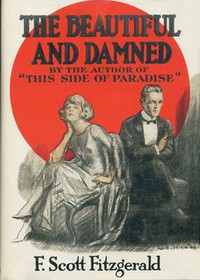
The Beautiful and Damned — Background and Themes
Edition facts
From its opening pages, The Beautiful and Damned establishes a narrator who treats irony as a kind of intellectual polish, describing it as “the Holy Ghost of this later day.” The protagonist, Anthony Patch, is introduced not through action but through a series of self-canceling contradictions: he wonders if he is “without honor and slightly mad,” yet also considers himself “rather an exceptional young man.” This double consciousness—oscillating between grandiosity and despair—shapes the novel’s psychological texture. The excerpts show a story less concerned with plot mechanics than with the slow erosion of ambition and affection, rendered through Fitzgerald’s characteristic blend of lyrical observation and sardonic commentary.
Irony as a Narrative Lens
The narrator’s opening declaration that irony has “descended upon” Anthony Patch frames the entire work. This is not a neutral chronicle but a story told from a knowing, slightly detached vantage. The prose itself performs this irony: Anthony is described as “a distinct and dynamic personality, opinionated, contemptuous, functioning from within outward,” yet the very next sentence undercuts him by noting he is “aware that there could be no honor and yet had honor.” The narrator refuses to let any trait stand unqualified. This technique creates a portrait that feels both intimate and judgmental, as if the reader is watching a character who cannot see his own contradictions.
The Weight of Social Inheritance
Anthony’s sense of identity is explicitly tied to his grandfather, Adam J. Patch, a figure whose wealth provides “social security.” The excerpts note that Anthony derives as much status from this lineage as “tracing his line over the sea to the crusaders.” Yet the novel undercuts this aristocratic posturing: the grandfather is described as “more familiarly” known, suggesting a mundane reality behind the grand name. The catalog subjects list “Inheritance and succession” as a theme, but the excerpts show that inheritance is less a plot device than a psychological anchor. Anthony’s sense of worth is borrowed, not earned, and the narrative keeps drawing attention to the gap between his self-image and his actual circumstances.
Decisions Made in Exuberance, Regretted in Sobriety
A key episode in the excerpts involves the impulsive signing of a lease for a house in Marietta. The decision is made during “a wild revel” and immediately regretted: “to their utter horror they signed it and sent it.” The language personifies the house as “drably malevolent,” “licking its white chops.” This pattern—grand gestures followed by crushing remorse—recurs in Anthony’s abrupt resignation from his job, which he mails in “a moody despair” and later wishes he could retract. The excerpts do not reveal the full arc of the marriage, but they show a couple whose choices are driven by momentary feeling, with consequences that feel both inevitable and avoidable.
The excerpts offer a concentrated sample of Fitzgerald’s method: a narrator who sees through his characters, a protagonist caught between self-regard and self-doubt, and a world where money and status are never quite enough. Readers should attend to the way the prose shifts between lyrical elevation and deflating irony—that tension is the novel’s engine. The catalog subjects point toward domestic fiction and psychological realism, but the excerpts suggest something more caustic: a study of how people undo themselves, one impulsive decision at a time.