
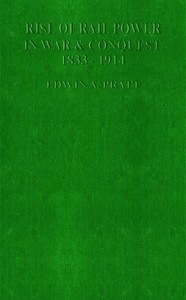
The Rise of Rail-Power in War and Conquest, 1833-1914 by Edwin A. Pratt
The Story
This isn't a novel with characters, but the story it tells is more gripping than fiction. Pratt tracks the railroad from its birth as a curious new machine to its role as the central nervous system of nations at war. He starts in the 1830s, when generals first saw trains move troops faster than any horse. The book then follows this idea across continents and decades—through the Crimean War, the American Civil War, the Franco-Prussian War, and right up to the eve of World War I. It shows how Prussia used its superior rail network to crush Austria and France in weeks, and how the lack of a good railroad system doomed the Confederacy. The 'plot' is the slow, inevitable realization by every major power: control the rails, or lose the war.
Why You Should Read It
What hooked me was how Pratt connects dots you never thought were linked. You see a map of Europe from 1914 and understand why the borders are where they are—rail lines dictated supply, and supply dictated conquest. He makes logistics, usually the driest subject, feel like a secret history. You stop seeing trains as just trains and start seeing them as the delivery system for everything from bullets to nationalism. It’s a masterclass in how a single technology can bend the course of history, written with a clarity that makes complex strategies easy to grasp.
Final Verdict
Perfect for history buffs who are tired of the same old stories about kings and battles, and for anyone who enjoys 'big idea' nonfiction that explains how the modern world was built. If you liked books like Guns, Germs, and Steel for their sweeping theories, you'll love this deep dive into one specific, world-altering invention. It’s a niche topic, but Pratt makes it feel essential. Just be warned: you’ll never look at a train station the same way again.
This work has been identified as being free of known copyright restrictions. Use this text in your own projects freely.
Edward Thompson
1 year agoI have to admit, it creates a vivid world that you simply do not want to leave. Worth every second.
Elijah Thomas
10 months agoAfter finishing this book, it manages to explain difficult concepts in plain English. Absolutely essential reading.
Brian Taylor
11 months agoAfter finishing this book, it challenges the reader's perspective in an intellectual way. Truly inspiring.

Richard Martin
1 year agoPerfect.