At Sunwich Port, Part 1. Contents: Chapters 1-5 — Story, Setting & Ideas
Edition facts
W. W. Jacobs opens At Sunwich Port with a town that is both drowsy and sharply observed. The July afternoon is described through a rattle of cranes and winches, but also through shopkeepers veiling their faces from flies and small boys listlessly watching the church clock. This blend of industrial sound and domestic stillness sets a tone of ironic detachment. The narrator’s voice is wry, noting that Sunwich is proud of its church tower, which rises suddenly to display a black-faced clock with gilt numerals. The description is precise, almost architectural, yet undercut by a hint of the town’s self-importance. Jacobs uses sensory details—smells of tar, rope, and fish—to anchor the reader in a specific maritime world, while the characters’ inner lives are revealed through their reactions to this setting.
Ironic Narration and Understatement
The narrator’s tone is consistently ironic, often undercutting characters’ perceptions with dry commentary. When Captain Nugent storms through Sunwich after a court of inquiry, the narrator notes that he longed to be aboard ship again “with the Court of Inquiry to form part of his crew.” The hyperbole is understated, delivered without exclamation. Similarly, Mr. Wilks, the steward, is described as having “an expressive face,” and he works his features into a state of “much satisfaction at his powers of endurance” while trailing his captain. The comedy lies in the gap between the steward’s self-regard and the captain’s obliviousness. Jacobs rarely tells the reader how to feel; instead, he presents actions and lets the incongruity speak. The phrase “sublimely ignorant” is a characteristic touch—formal vocabulary applied to a mundane failing.
Dialogue as a Tool for Character
Dialogue in these chapters reveals character through rhythm and word choice rather than exposition. Captain Hardy’s speech is blunt and authoritative: “You’re running wild,” he tells his son, and later, “You want looking after, my son; I’ve heard all about you.” The son’s replies are evasive and self-justifying, as when he “denied it at once upon principle” without knowing the accusation. Jacobs captures the push-and-pull of a parent-child argument through short, clipped exchanges. The father’s plan to send the boy to an aunt is delivered with a dry finality: “A year or two with your aunt ought to make a nice boy of you; there’s plenty of room for improvement.” The aunt is described only through hearsay—her “strength of mind” is enough to make the boy anxious. Dialogue here does not advance plot so much as it etches personalities.
Description of Objects and Spaces
Jacobs pays careful attention to physical objects, using them to convey emotional states or social dynamics. The wardrobe that proves “a particularly hard nut to crack” is not just a piece of furniture; its destruction during removal becomes a small comic set piece. The movers “succeeded at last—in three places,” a punchline that deflates any sentimentality about leaving home. Later, Miss Nugent’s selective attention is shown through her movements: she appears only when fine pieces are being loaded, but vanishes when a broken washstand or a two-legged chair emerges. The empty house at the end is described with stark simplicity: “nothing was left but a litter of straw and paper.” The front door stands open, “revealing desolation.” These details are concrete, never abstract, and they carry the weight of the scene without authorial commentary.
The Role of the Illustrations
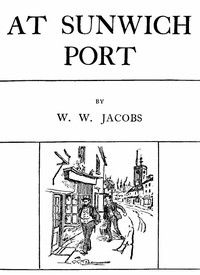
The list of illustrations in this edition offers a visual counterpart to Jacobs’s text, and the captions themselves are worth noting. Phrases like “His Perturbation Attracted the Attention of His Hostess” and “A Welcome Subject of Conversation in Marine Circles” echo the narrator’s ironic tone. The illustrations, by Will Owen, are placed at moments of comic tension or character revelation. For instance, “Captain Hardy Lit his Pipe Before Replying” suggests a pause that the text may not explicitly describe, while “Mr. Wilks Watched It from the Quay” captures the steward’s habitual role as observer. The captions often function as miniature punchlines, reinforcing the dry humor of the prose. They also hint at scenes not fully excerpted here, such as “Most Comfortable Shoulder in Sunwich,” which promises a moment of ironic tenderness.
These first five chapters establish a world where temper and pride are constantly checked by circumstance. Jacobs’s authorial choices—the ironic distance, the precise physical detail, the dialogue that reveals without explaining—create a tone that is both affectionate and unsentimental. Readers attentive to the interplay between what characters say and what the narrator implies will find a comedy that depends on understatement. The excerpts offer only a partial view, but they suggest a narrative voice that trusts its audience to read between the lines.