At Sunwich Port, Part 3. Contents: Chapters 11-15 — Text and Context
Edition facts
Part 3 opens with Jack Nugent torn between filial duty and resentment, a conflict that the Kybird family exploits with characteristic self-interest. Mr. Kybird’s refusal to host Captain Nugent—‘An Englishman’s ’ouse is his castle’—is immediately undercut by his wink to Mrs. Kybird, signaling a private scheme. This small gesture typifies Jacobs’s method: characters’ words and actions rarely align, and the reader must watch for the gap between what is said and what is meant.
The excerpts also introduce Nathan Smith, a boarding-master whose ‘colourless eyes’ and blank expression make him an unnerving negotiator. When a visitor offers him a cigar, Smith’s suspicion—‘I ’ave heard of ’em exploding’—prompts genuine laughter from the other man, a rare moment of unguarded mirth that hints at the story’s tonal range.
A Father’s Unbending
Captain Nugent’s attempt to ‘crimp’ his own son—forcibly enrolling him on a ship—is the dramatic hinge of these chapters. The scheme fails, and Nugent wakes with a ‘bad headache’ to find himself aboard the Conqueror, his old vessel. The disorientation is rendered through sensory detail: the unfamiliar height of the bunk, the ‘frouzy bedclothes’, the motion of the ship. Jacobs uses the captain’s confusion to re-establish setting without exposition, letting the reader piece together the situation alongside him.
When Nugent recognizes Captain Hardy on the bridge, his imperious command—‘Put me ashore’—is met with Hardy’s deliberate, legalistic response: ‘This man is not one of the crew, Mr. Prowle?’ The exchange underscores the power shift; Nugent’s authority evaporates the moment he is no longer on his own ship. The scene is both comic and tense, as the reader knows more than either captain.
The Art of Indirection
Jacobs’s dialogue is a masterclass in saying one thing while meaning another. Mr. Kybird’s advice to Jack—‘take the advice of a man wot’s seen life, and go’—is layered with self-interest, though he presents it as paternal wisdom. Mrs. Kybird’s interjection about breaking off the engagement with ’Melia reveals the family’s real concern: preserving the match. Their arguments are never straightforward; they circle, hint, and retreat.
Nathan Smith’s conversational style is even more oblique. When he claims he was Amelia’s godfather, the statement is delivered with a blankness that makes it impossible to verify. The narrator notes that Smith ‘seemed to be looking through his opponent at something beyond,’ a habit that discomfits everyone. This indirection is not just characterization—it drives the plot, as characters consistently misread each other’s intentions.
Physical Comedy and Setting
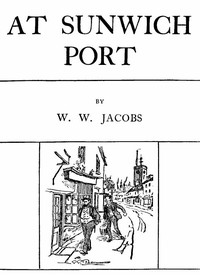
The excerpts are punctuated by moments of physical humor that ground the verbal sparring. Captain Nugent, trying to rise from his bunk, ‘nearly rolled out’—a small, undignified stumble that undercuts his bluster. Later, a character falls ‘on all fours into the room,’ and another pushes open a ‘small lattice window’ to peer into an alley. These actions are precise and visual, suggesting the illustrator Will Owen’s influence on the narrative’s comic timing.
Setting is similarly functional. The Conqueror is described through its motion—‘rolling in a fresh sea’—and sounds: ‘loose gear rattled’ and a ‘distant tinkle’ from the steward’s pantry. Sunwich itself appears only as a ‘cold and cheerless’ view beyond ‘dirty, tumbling seas.’ Jacobs does not linger on atmosphere; instead, he uses place to reflect character. Nugent’s disorientation on the ship mirrors his loss of control over his son.
The Limits of the Excerpts
These five chapters form only part of a larger novel, and the excerpts leave key questions unanswered. How did Captain Nugent end up on the Conqueror? The text implies a conspiracy involving Nathan Smith, but the details are withheld. Similarly, Jack’s relationship with Amelia Kybird is referenced but not developed; the reader sees only the family’s maneuvering, not the couple’s own feelings.
The excerpts also do not reveal the outcome of the confrontation between Nugent and Hardy. The story cuts off with Hardy’s puzzled inquiry, leaving the resolution suspended. Readers approaching the full novel should expect these threads to be resolved through further complications rather than simple explanations. Jacobs’s plotting relies on coincidences and misunderstandings, and the pleasure lies in watching them unravel.
These chapters reward attention to what characters do not say. A wink, a hesitation, or a misplaced cigar can carry more weight than a page of argument. Jacobs’s humor is dry and cumulative; the comedy emerges from the collision of stubborn wills and imperfect information. Readers will find that the story’s momentum depends less on grand events than on the small, precise details that accumulate into a satisfying whole.