
At Sunwich Port, Part 4. Contents: Chapters 16-20 — Edition Insights
Edition facts
The opening of Part 4 finds Miss Nugent and Mrs. Kingdom reacting with 'consternation' to the news that Captain Nugent has stowed away aboard the Conqueror, the ship commanded by his old enemy, Mr. Hardy's father. The catalog subjects list 'Fathers and sons' and 'Family — England — Fiction,' but the excerpts focus more on the stubbornness of fathers and the romantic maneuvering of the younger generation. Hardy proposes that he and Miss Nugent 'set them a good example' by becoming friends, but she responds with 'disconcerting composure,' asking bluntly why he wishes to be on friendly terms. This exchange sets the tone for a narrative driven by pride, miscommunication, and the social codes of a small port town.
Pride and Prevarication in Equator Lodge
The Nugent household is portrayed as an 'impregnable fortress' after the captain's departure. Hardy's attempts to approach Miss Nugent are met with a bow 'exactly half an inch in depth' and a glare from Captain Nugent that he recalls 'in all its appalling virulence.' The catalog subject 'Betrothal — Fiction' is hinted at, but the excerpts show no formal engagement—only Hardy's persistent, rebuffed efforts. Mrs. Kingdom, meanwhile, is caught in her own contradictions: she claims to have pictured the captain 'walking about the streets of London, wrestling with his pride,' but her niece maliciously reminds her of this when the truth emerges. The domestic comedy lies in the gap between what characters say and what they know.
Fullalove Alley: Gossip and Misunderstanding
The subplot in Fullalove Alley revolves around Mr. Wilks, Mrs. Silk, and the steward. Mrs. Silk has quarrelled with her son Teddy over the steward's presence, and Mr. Wilks complains that 'to 'ear people talk you'd think it was my fault.' He describes Mrs. Silk's tactics as 'so sudden in what she says there's no being up to 'er,' citing her question about whether he would be sorry if she died. His reply—'yes'—is followed by the qualifier that she shouldn't 'let my feelings interfere with 'er in any way.' This blend of politeness and passive aggression is typical of Jacobs's dialogue. The alley's gossip amplifies every rift, and the steward's drunken episode—waking to find himself 'standing at the open door with the cold night air blowing in his face'—adds farce to the social tensions.
Illness and the Limits of Sympathy
Hardy's partner falls ill after a chill caught while bathing, and the excerpts show him taking 'a greater interest in medical works than his doctor deemed advisable.' Hardy is left to grapple with the partner's work, having first pitched a portion of it 'on to the floor' after being advised to 'work more.' The partner's levity—recommending 'love-philtres' and a specialist for 'diseases of the heart'—is met with Hardy's 'evil temper' and 'incisive remarks on levity unbecoming to age.' The catalog subject 'Ship captains — Fiction' is peripheral here; the focus is on the mundane crises of a small business and the strain of unrequited affection. Hardy's depression is noted but not elaborated, leaving the reader to infer the emotional cost of the Nugent feud.
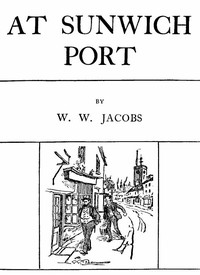
Readers should attend to the way Jacobs uses dialogue to reveal character: the clipped formality of Miss Nugent, the bluster of Mr. Wilks, and the passive aggression of Mrs. Silk all advance the plot without authorial commentary. The serial format means that each chapter ends on a note of suspense or comic resolution, but the larger arcs—the captain's return, the fate of the betrothal—remain unresolved. The illustrations by Will Owen, listed in the contents, offer visual cues to key scenes, such as the steward's drunken exit and Captain Nugent's glare.