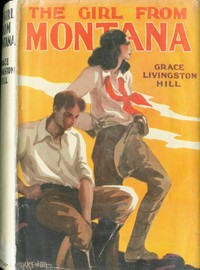
The Girl from Montana — Story, Setting & Ideas
Edition facts
The novel opens with a precise, tense image: the girl steals around her cabin as late afternoon sun streams across the floor, her face showing "tremulous courage." She enters shuddering, haunted by a "long procession of funerals" and the recent, unhallowed burial. This is not a leisurely western; the prose is immediate, focused on physical and emotional peril. The girl's flight begins within the first chapter, and the narrative follows her through a series of narrow escapes—from a threatening man, a house of ill repute, and the wilderness itself. Hill's style is brisk, favoring action over introspection, yet she pauses for telling details: the horse's lameness, the clean white nightgown smelling of rose leaves, the old woman who calls her a "home mission." These small, concrete observations ground the story in a specific, tactile world.
Peril and Providence on the Frontier
The opening chapters establish a pattern of danger and deliverance. The girl, Elizabeth, is alone after a death; she must perform a duty, then flee. The threat is immediate and physical—a man pursuing her, a house from which she escapes by pointing her pistol. Hill does not romanticize the frontier: it is a place of "primitive, unhallowed" burials and "dens of iniquity." Yet she also introduces helpers: an old woman who provides clean clothes and calls her escape a "miracle," a farmer who advises on the lame horse. These encounters are brief but vivid, each stranger offering a different kind of aid—practical, moral, or spiritual. The narrative moves quickly, but the reader notices how often Elizabeth's safety depends on the kindness of others, and how her own resourcefulness—her pistol, her careful watching—is equally crucial.
Clothing as Armor and Identity
Hill pays unusual attention to what Elizabeth wears. Her original clothes are "about wore out"; the old woman gives her a dark-blue serge skirt and coat, white shirt-waists, and undergarments from her own meager wardrobe. Elizabeth surveys herself in a glass and feels "vanity" born, along with an ambition to be always thus clothed. But she also remembers the woman who promised "pretty clothes" as a snare. The text links clothing to moral danger: the girls in the house of ill repute may have been lured by finery. Clean, modest garments become a kind of armor, signaling respectability and aiding her passage. Later, the old overcoat protects her from freezing as she rides into Philadelphia. These details are not mere description; they carry thematic weight, connecting appearance, virtue, and survival.
The Journey as a Series of Tests
Elizabeth's journey from Chicago to Philadelphia is not a smooth transition but a "slow and painful" ordeal. The horse goes lame; money dwindles; she must ask for help from policemen, farmers, and strangers. Hill notes that the full story "would fill a volume" but might "pall from the very variety of its experiences." This self-aware aside suggests a deliberate selection of episodes. Each stop becomes a test: of trust, of judgment, of faith. The old woman who reads the fourteenth chapter of John is listed among "saints"; others are less reliable. Elizabeth grows "sadly wise" and "less sweetly credulous," yet she persists. The narrative emphasizes her active role—she "fared forth" with blessings and advice, but also with a pistol and a wary eye. The journey is both physical and moral, a gauntlet that reshapes her.
Readers should attend to the novel's rhythm of crisis and respite. Hill builds tension through short, action-driven scenes, then releases it with moments of domestic calm—a clean room, a meal, a night's sleep. The religious language is woven into the fabric of the story, not preached: characters are judged by their deeds, and Elizabeth's faith is shown through her resilience. The excerpts offer only a portion of her journey; the full novel likely extends these patterns of flight, pursuit, and unexpected sanctuary. Approach it as a narrative of survival where every detail—a horse's lameness, a borrowed skirt—carries consequence.