
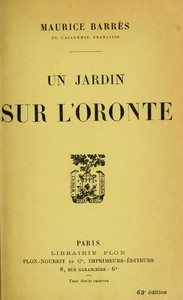
Un jardin sur l'Oronte by Maurice Barrès
First published in 1922, Maurice Barrès's final novel transports us to the Syrian coast during the time of the Crusades. It’s a world of uneasy truces and cultural collisions, painted with vivid, almost sensual detail.
The Story
The story follows a young French knight, Guillaume, who is taken prisoner by a Muslim emir, Ali. Instead of a dungeon, Guillaume is treated with honor and brought to live in the emir's palace on the banks of the Oronte River. There, he encounters Oriante, the emir's captivating and intelligent wife. What begins as curiosity between two people from opposing worlds slowly deepens into a profound and forbidden love. Their secret meetings in the palace's lush garden become a sanctuary, but also a ticking clock. The threat of discovery by the emir—and the violent consequences it would bring—hangs over every stolen glance and whispered word.
Why You Should Read It
This book surprised me. It’s less an action-packed war story and more a deep, psychological look at attraction and loyalty. Barrès gets inside the heads of his characters. You feel Guillaume’s torn conscience and Oriante’s quiet rebellion. The ‘garden’ itself is a powerful symbol—it’s this beautiful, isolated space where their love can grow, but it’s also a trap, surrounded by the walls of duty and war. The writing is lush and atmospheric; you can almost smell the orange blossoms and feel the tension in the air. It asks big questions about where our true loyalties lie: with our faith, our people, or our own hearts?
Final Verdict
Perfect for readers who love historical fiction that focuses on human drama over battlefield tactics. If you enjoyed the emotional tension of 'The English Patient' or the cultural exploration in Amin Maalouf's novels, you’ll find a lot to love here. It’s a compact, powerful story about an impossible choice, and it proves that some of history’s most compelling conflicts happened not between armies, but within a single, conflicted heart.
Legal analysis indicates this work is in the public domain. It serves as a testament to our shared literary heritage.
Patricia Rodriguez
8 months agoVery interesting perspective.
James Nguyen
1 year agoSolid story.


William Sanchez
9 months agoAmazing book.